Wednesday, 5 June 2019

our man abroad..

MASSACHUSETTS GAZETTE


Our correspondent, Wilbur Schlager, has returned from the old world with correspondence and illustrations from the recent conflict in Bavaria.

Six weeks at sea has cured this correspondent of his travel bug, thirteen in total if you include the return in an unfavorable wind and so you will be reading of the campaign in Bavaria some two months since the last shot was fired and the forces of Napoleon Bonaparte were marching on Vienna.


On my arrival and travels north I had to regularly try to gain intelligence on where the armies were mustering. For the French and allies I was told to make for Ingolstadt on the Danube. A journalist constantly runs the risk of being taken for a spy and my neutrality as an American citizen and enthusiasm for whichever side I was currently engaged with stood me in good stead. My Purchase of both a Bavarian and Austrian rosette from a reputable Dutch tailor was also a boon on close inspection although I feared discovery of 'the other' every time a soldier took a little too much interest in my possessions. 


From Ingolstadt I followed the armies march towards Regensburg, to travel in the wake of an army is woeful. Food and wine will be in short supply, prices high, and abused citizens may be angry with strangers, again I played my sympathetic aüslander card. Even in the wake of their own troops suffering is not uncommon and the weather had been unseasonably bad making transport slow.


It was a Bavarian corp that I caught up with on the 20 April. I was off the road in flat country, scattered with woods and farms. The roads heavy with supply wagons and guns. It cost me half a bottle of rum to get a seat by a fire. They seemed confident, thinking the foe must be worse off than themselves, and Napoleon had arrived whom they seemed to have confidence in. 


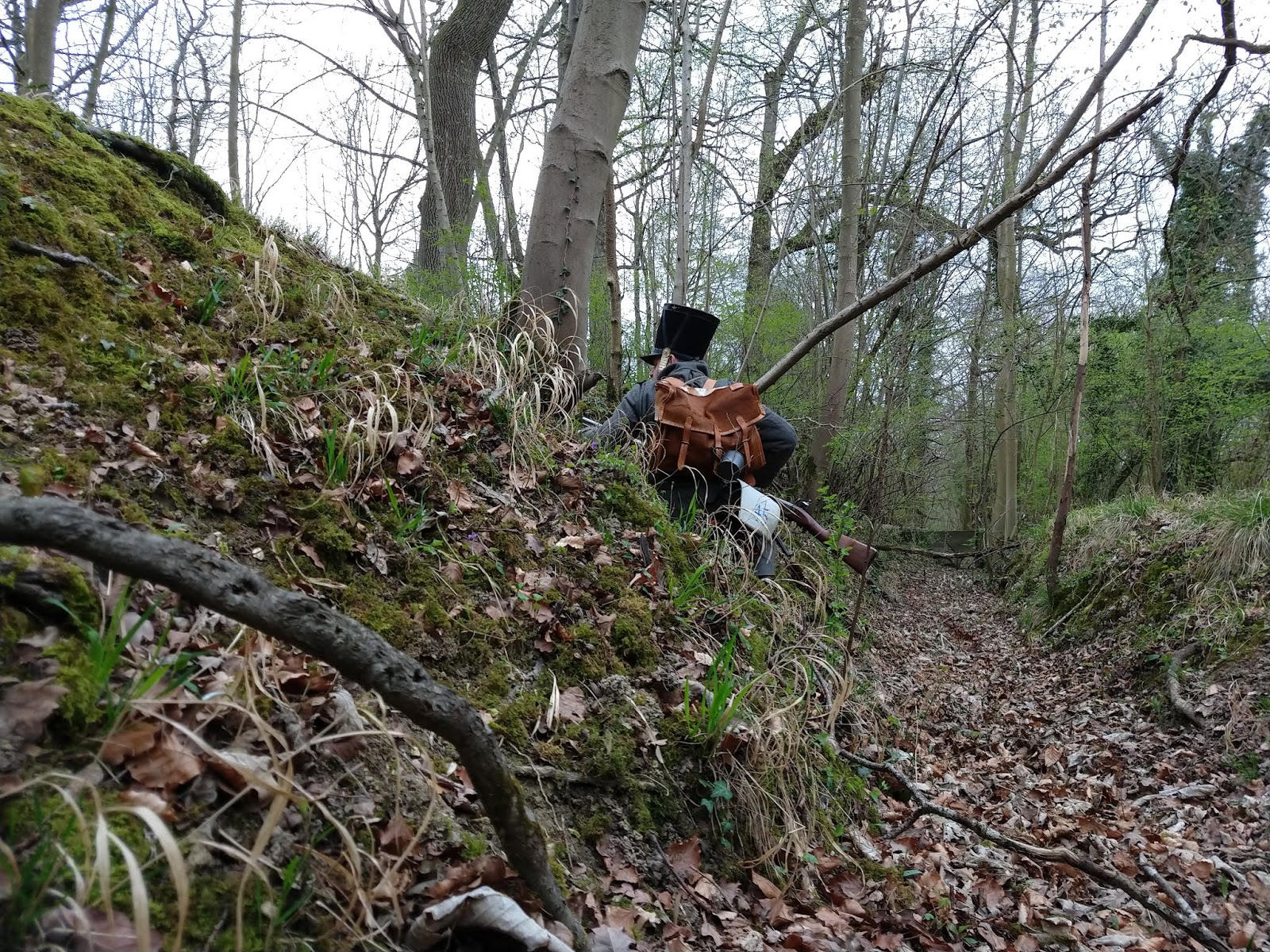
My experience of what I would later learn was the battle of Eggmühl was limitted to one small corner of the sprawling conflict. I fled from a small wood when I took a dislike to the number of cannons pointing my way and found myself on the lip of a rise with a column of Austrian Grenadiers marching forward, groups of grey clad jeagers in hunters hats flitted around them and engaged with their opposite number.


  I believed the Austrians had the better of it from their initial advance and sounds of melee but the white coats were soon in retreat, cannon shot ringing after them.
 I moved for comfort, I shall never forget the brute force of a cannon ball plunging through a light wood as if the trees were matchwood kindling, as if the devil himself, all enraged were crashing through the trees.


From my new perch I saw a Bavarian troop asail the wall around the Schloss Eggmühl, called a castle it's likeness is like that of a French châteaux, more mansion than stronghold yet a wall of stone yet made the assailents pay in blood before the ladders were raised and smoke indicated fighting beyond.


An officer of the 2nd Bayerische Chevaux-legere informed me that the battle was won, yet my ears told me blood was still being spilt and There on the flank battle was given next day. There is little love even in peace time between these neighbours.  I heard 6000 had fallen on the Franco-German side and twice as many of the Archdukes men. 


The sorrow of war is I would meet a Bavarian soldier and chat in ernest, then hours later be in conversation with a fine Austrian, and wish them both well, hoped they both would have good fortune yet both may end up a victim of the other.


The army, for I found myself again with the same Bavarians, marched onwards to reach Regensburg and a seige, for that famous stone bridge has stood some six hundred years and defied both sides attempts at destroying it. Panic started in the army as I was on the outskirts of the small conurbation, much damaged, north of the Danube, Napoleon was dead!

 But no fear, he soon made a supreme effort to show it was but a wound to his foot. Lannes, frustrated by failure, now snatched up a ladder and retorted 'I was a grenadier before I was a Marshal, see how a wall is carried!' His example inspired the men to another assault that carried the day.

I did not go into the smouldering town, but lodged one night with the baggage and headed east along the river and enjoyed the growing prosperity as I voyaged south and so to the sea, away from the war. It is America's blessing that war has not laid our towns and villages to waste in our generation and long may peace reign.

Wilbur Schlager, Boston, June 1809.


Monday, 20 May 2019

Battle of Lewes!

Lewes is probably the nearest place to me that has a semi-regular reenactment event, but I've never managed to get along and indeed in 2019 I was set to be in Almelo, Holland, but my appendix intervened and blew up. Can't be doing anything taxing as it heals up. A foray to Lewes as a non combatant however would be a welcome change of scene for the day.
On Lewes bridge with the mayor (obscurred by large armoured men), that is Simon De Montfort in foreground with the dastardly king, his foe, to his right. The appearance at the castle and here was to advertise the event and the Sunday battle.


Back at the convent field the weather turned, I prayed for intervention and said the sun would come out for the battle, no one would have to die in the rain, and I'm sure it worked.


 'Oh you're a monk!'

Is the general public response, understanbly enough to my new guise which I got a couple of years ago but not had an appropriate outing for it, however I am not a monk.. making the reenactor in me want to put them right.. well it's a conversation opener!
 A monk removes himself from the world to contemplation in a monastery. A friar is the opposite, out in the world, hands on, helping the needy and spreading the word.


 Saint Francis, founder of my order, had been wealthy as a youth and briefly a soldier in Italy but repented of his worldly ways. As a non religious person I would come at this role by remembering my admiration for this, friars and Fransicans especially are my idea for how Christians should be, not wealthy and preaching from comfort but living by example, One fellow asking me questions announced that he was a catholic and for a moment I thought he might take umbrage at someone depicting a religious figure, but he didn't and I feel as long as I respect the role no one really should.


I didn't take to the field given my convalescent state but watched the crowd line and let down the rope when the troops went on and off. It was a modest affair with more folk expected the next day. There was one participant pf note whom seemed to have come to a medieval battle as a 1970s Biker, but with a sword and shield!   Ive never really seen anyone who looked a bit.. lost? No one had said anything, maybe they didn't have the heart?  How do you even do that if you are the organiser at a small event?  Mate, this is the battle of Lewes, 1264, not Easy rider, 1964.


The mysterious mound near the convent field is actually.. , no one knows, maybe something to do with Druids. especially if you know Lewes.

It's a pleasant local event and I believe they will try and make it a semi regular feature, events often grow when groups get used to set dates to put in the calendar. I loitered for a bit with the Free company, some of whom also appear in these adventures as the Napoleonic sappeurs, and then wondered like a pilgrim to the train station all of two minutes up the road.

                              Tempus est ire in domum suam. Time to go home.


Ickworth III


My third Ickworth, always a good kick off for the season and always cold or wet or cold and wet, or wet and cold.
l did have a slight sense of trepidation though. Last year was without any of these Napoleonic association camp behind a country house/battle in the afternoon/socialise around fire in evening events and I wondered if I would still enjoy myself as much, last year having been heavy on campaign and foreign events.


What wasn't typical was splitting the armies in two as their was a test for a future campaign event on the site and the NA wanted to see how the space worked and try some objectives out. It would also be a good taster for those unfamiliar with this sort of running skirmish and treks. The sides were all the riflemen Vs 16 French volunteers, of whom I was naturally one.


One of the NCOs observed that the group seemed to have forgotten that troops do actually form units and fight/march in formations when not actually skirmishing My own view was that this was new to quite a few and the novelty of ducking and weaving and firing round trees had overtaken them, it was a different format to standing shoulder to shoulder and listening to orders and it was fun, plus the hotch potch group had lost its recognised command structures, bar the overall officer, which may have added to the impression.


It certainly didn't hinder effectiveness or elan and I think the French spirit worked particularly well in firing the troops up. The Rifles enjoyed the event and admitted they found it galling to cope with us playing them at their own game. Their attempt to outflank us making us pivot around firing from different directions, the hunters had become the hunted! 


Before I'd even fired a shot I went to show a family how a musket worked, including how when you pull the trigger the flint hits the frizzen and sends sparks down into the powder.. Gchink! The end of the flint just chipped away. This would be the way of it all weekend, I got through seven flints in two days, must have been a very brittle batch. Someone somewhere must dig up masses of flint just for reenactors.


The battle on Sunday started well with the bagpiper being surprised and shot, if only this could happen sooner,  Friday afternoon for instance or before they leave the house.
Our plucky vanguard of Sappeurs was soon overcome by a cavalry charge, something they have a dramatic talent for.
Then we, the main army, marched on from the flank having all filed over a wall, shhhh! Down the far corner and hopefully surprising the audience although quite a few of the British have probably seen this ruse at Ickworth before it does work well.It was a lively engagement with two wings fighting it off and the smoke hanging in the damp air. 


But the day was not ours, apparently decided at the officers meeting by a coin toss!  The vengeful redcoats decided to shoot our medical infirmiere but he legged it to much applause. 


A good weekend all round.

Monday, 12 November 2018

Night in the Trenches.


The weekend of 10/11 November 2018 of course marked 100 years since the end of World war one and saw commemoration events all over the world. There had been a plan to go to France but it fell through due to lack of information/planning but then there was Night in the Trenches at the Staffordshire regimental museum.

I had misunderstood when I first heard of the event and thought it was actually all night in the trenches and apparently it once was but a change in management decided they didn't want people on site overnight, especially not with sporadic fighting, and it would be tidied away by 23:00.
Tommy only needs a cup of tea and he's happy.


I was clearly having a bad day as I was captured six times! During each public trench tour a British team would capture an unwary Bosch and deliver him under fire for interrogation, which was quite hairy and I pretty much fell into the trench on the last occasion, which added to the realism and made children cry (again).
These duties were shared with Martin (a proper actor, above right) and we both shouted very German sounding nonsense on delivery ''Der Kuhlschrank ist Leer! Der Kuhlschrank ist Leer!' (The refrigerator is empty) and 'Meine hase ist im krankenhaus! (My rabbit is in the hospital).
 Being marched out through the allied trench led to more jokes. ''Didn't we capture your brother earlier?" and "look out they've started cloning!" 


The battles were after the fourth and eigth tour and involved fire between the trenches, both of which had a machine gun, and a few bombs going off, so pretty noisy and atmospheric in the dark. Then the French would get into the left flank of our trench and drive us out before we counter attacked.. a grand attack from all the French/British/Americans would then over run us and the survivors were marched out as prisoners, then formed up for the public.

As a medic I was quite distracted by dealing with the wounded, applying bandages and morphine whilst the chaos went on around me. Only really knowing we'd been over run when a Tommy was herding my comrades passed. 

There was soup and sandwiches at half time then we did it all again! 

So on Sunday morning I was traveling home, just coming into Kings cross at 10:54.. was in St Pancras international at 11:00 and just took my hat off and stood quietly. It was all a bit anticlimactic but I felt in a way that I was reminding people as I travelled through London in uniform, kit bag over shoulder that these stations had seen thousands of soldiers, often conscripts, pass through, a great many never coming home.

And so also ended my reenactment year, quite late being November. Quite a lot to look back on like the adventures in Malta and my first great war shows which seem set to continue despite a predicted drop in big events, much as was said when the Napoleonic bicentennial events came to a close. People with a passion for the era will keep it alive!

No more events but may post up the odd editorial piece in the off season.

Looking forward to 2019, hope to see you there!


Friday, 26 October 2018

Völkerschacht 2018

Five years ago I came to Leipzig for my first continental event, what a kick off that was with thousands of participants and my first time in battle firing a proper musket. Could the 205th anniversary be as rewarding?

Old Leipzig.

New Leipzig.


I flew out for a couple of days before the actual reenactmenty-bit and really enjoyed myself, Leipzig is a great place to visit for its cafe culture, museums and art, both classical and modern and sometimes painted onto big buildings. Having been twice I now regard Karl-Liebkneckt Strasse, known as 'Karlli' as my other neighbourhood.

It was Friday lunchtime when I found my way to the bivouac at Tollhaus Dollitz, one of three sites, this was for the artillery park of both sides and the Prussian brigade.


Now, originally there had been an idea of Landwehr unit from England joining the brigade alongside the Russo-Prussian artillery (UK) but for various reasons it ended up with... just me.
 I did consider going as an Austrian officer who was separated from his unit but a musket was available to borrow and so I stuck with the original plan, and did not regret it. The Landwehr were a militia who in reenactment terms the only real addition I had to get was the litewka (coat) and feldmütze (cap) as equipment was in short supply in 1813 and much was supplied from abroad, such as Britain or from captured gear.

Different regions had different colour facings (piping, collar, capband etc). Mine was yellow and Silesian, from the East, which included many non-German speakers. True to form my comrades were Czechs and Poles.

Hauptmann-Joe adds my name to the roster. I got to experience first hand what was a common feature of the black powder era, being a foreign soldier assigned to a unit as the flotsam and jetsom of war. On Saturday morning there was drill and I was glad a lot of the basics were similar to French, especially footwork, some French commands that sound like a whole sentence are just Two words in German, perhaps surprisingly.. Only a rather convoluted  ein-twie-drei-hands-knees-and-whoosy-daisy musket wheeling move confused me, but that never actually came up in the battle of course.

First official engagement had been the opening of the event at a ceremony at a palace (well, a very large fancy house) just north of the city centre which was present in 1813 and used as a hospital. It was quite a modest turn out as it was still Friday afternoon with many people just arriving. The Russo-Prussian artillery therefore made up the largest single regiment and everyone got a double ration of the beer laid on.


Day of battle.. after the drill we marched to the Markleeburg camp for lunch. In the UK  battalions do not fit bayonets very often, and certainly don't melee with them attached, which I think is a shame as it does look better and more imposing as well as being the right impression. Everyone with a musket knows not to point the barrel at anyone so this naturally leads to a bayonet never being level when troops come to the fray as they naturally become raised and crossed, but.. oh well.


Anyway, we marched to the big field.. we marched over the big field.. we marched across the next big field.. until we were apparently at Liebertwolkwitz and then took a rest as everyone formed up.

We in the Prussian brigade along with some Swedish troops and Tyrolean jagers were the reserve and after a short fiery speech from General Blucher we were left in the field behind the battle. The Austrians spearheaded the attack and most of the artillery was already in place. We waited and listened to the guns and the rockets and the cries.. I hoped we were not going to march on just near the end.
One of those moments that stay with you occurred when the cavalry passed down a narrow track in file with dust and smoke siloetting them between the trees, when we marched on between a gap in those trees another scene occurred as marching up a slight slope you could see everyone in our brigade, we had the sun ahead of us so that it passed through the silk of the flag.
Suddenly we were fighting, loading
and firing at the French.


Above is the moment we took to the field and the contest opened up.. soon a major charge made us fall back in disarray. We crossed bayonets with Poles and Bavarians and having fought through the latter I was outnumbered and fell.. I called on one of them to remember he was my brother and join us!  He didn't, but did give up on trying to steal one of my shoes, so it was a partial win. A doctor and nurse assistant ran to my aid and I managed to limp back to the unit.


The combination of dust from the loose soil and drifting smoke made for some atmospheric scenes.

Charged by dragoons and hussars we formed square amid the human wreckage of the fighting.

Das booom! not pictured but very much present was an Austrian mortar which used up a whole bag of powder with each mighty shot, the rockets were also noteworthy for adding to the atmosphere and I saw a couple land on spots where soldiers had been only moments before.

I confess I wasn't sure about the presence of British and Scottish troops (other than the Rocket troops who famously were there) because your putting on an historical battle then adding troops who had nothing to do with it.. and partially because if I travel a thousand miles across Europe I don't want to see more $%^*ing riflemen!  But on reflection I do see that in a land where most events are recreations of an actual battle that took place if you live in Dresden and want to be a Highlander you'd have to constantly travel to Belgium or Spain.. but then there was something like 23 armies involved in the Battle of the nations and 1813 campaign.. did none of them take your fancy?

So it was a great battle with us being well employed, as I think everyone was, and being quite mobile. A fine balance between being well organised but not scripted, I've no idea how much went as planned. The Saxons defecting to our side near the end was doubtless so and the length of the battle was about right.


Admitting defeat Emperor Napoleon leaves the battlefield his anger making him eschew the bus service provided.


The commemoration ceremony was a modest occasion on the Sunday morning, at first in the open park where there was a speech and 'Meine gute Kamerad' was played on a bugle. At the close there was a shout: French contingent: 
         Vive L'EMPEREUR!
         Vive L'EMPEREUR
                Viiiiiiive L'EMPEREUR!
(Pause)
         Blücher: We still won.


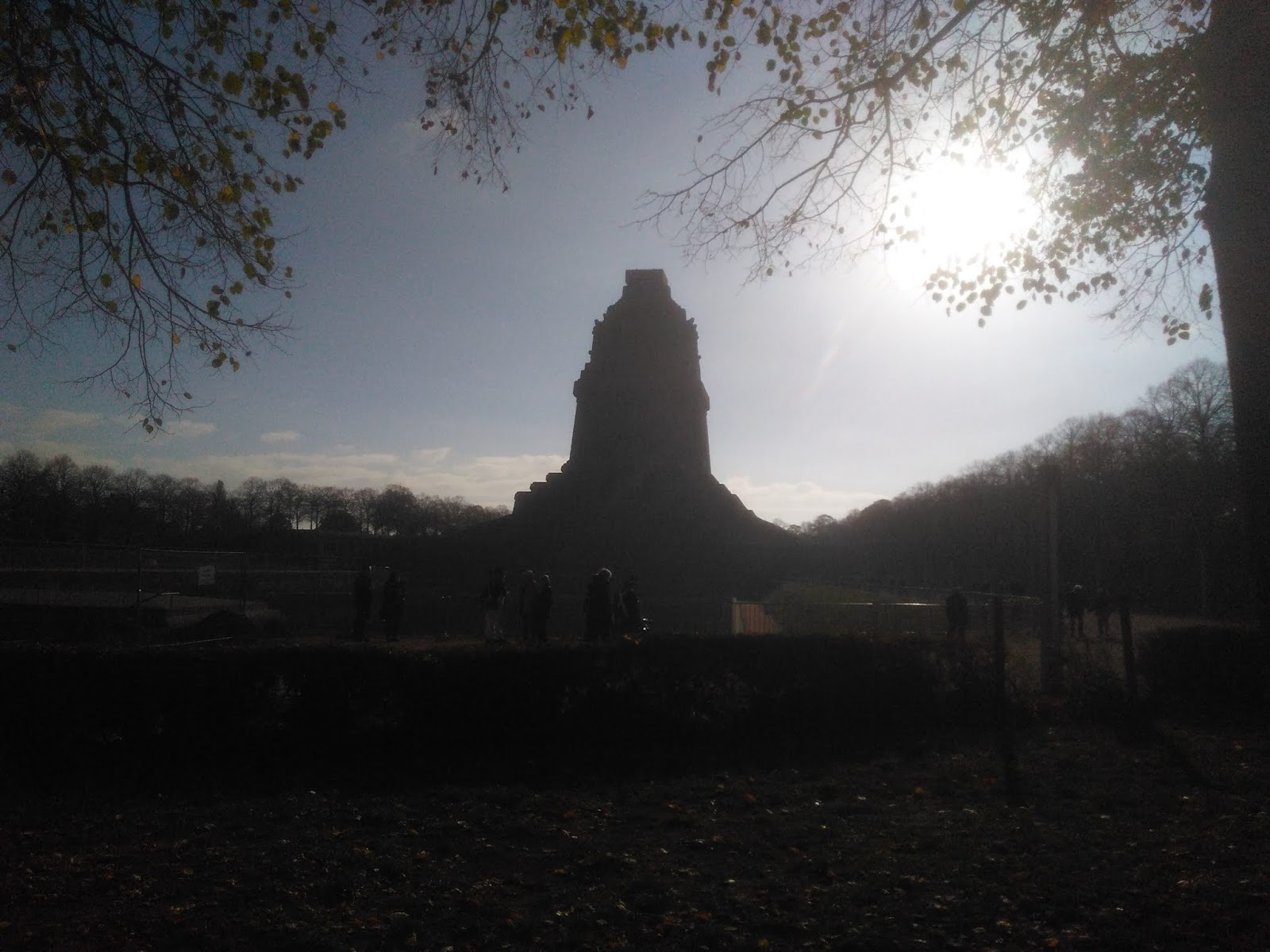
There was then a brief gathering of a few French and Saxons by the Napoleon stein.. a monument to where Napoleon apparently lost his hat when leaving the field. I visited the giant Völkerschlacht memorial and bid many of my comrades of the weekend farewell and marched back into town. I may well look into going next year, such a fantastic place! or see what other events are on such as Grossbeeren in the suburbs of Berlin, having made some friends I'd like to think I can drop in and join them again.  Bis Spater! (See you later!)


PROST! NOSTROVIA! SANTE!


Friday, 12 October 2018

Orchestral manoeuvres.

When is a reenactment event not a reenactment event?  As an example of the fabulous opportunities that can come up for reenactors I think it belongs here..

A post went up announcing that members of the 1914-21 society had been invited to attend the 'Concert for reconciliation' featuring the Royal philharmonic orchestra, in London, on Wednesday the tenth.
I said I'd like to go and got in touch with the organiser, however it appeared there were only two of us and both representing the central powers.. I offered to contact a couple of other groups. No takers. I had to cast my net wider and field a few enquiries, times, changing rooms, what duties were involved?.. but eventually we had a respectable team. I had not planned to become the point of contact but was pleased with how it worked out.

No one was going to sit next to me on the train.

It was a warm early evening and I strolled to Cadogan hall from Victoria station and with only one misstep soon found myself loitering outside and the other folk began to arrive. We then moved into the entrance hall and broke into strolling amongst the guests until the call went up for people to take their seats.
It was a mixed programme with Tchaikovsky, Scriabin, Vaugn Williams and George Lloyd amongst others, there was a strong Russian influence as the Embassy was involved in bringing the evening together, and our own involvement in it.


Sneaky picture, pointy finger.

More mingling at half time in the foyer and in conversation someone mentioned we were welcome to the refreshments in the hospitality room... Ding!  actually I was very good and let my fellows know about it before accepting a triangular sandwich and a glass of wine with some of the Chelsea pensioners who had come along.
The music continued but I think you would have been hard put to know there was a reconciliation theme to the evening, according to the programme many of the composers had connections with the great war but nothing was expressed and rather oddly two scenes from Henry V were enacted by an actorrrr.. including the Saint Crispian's day speech which is rather feisty.. not really a call for peace on earth!
Me, Fredericke Krum, the opera singer, the head of culture at the Russian embassy and... his mum? 

But the evening was not over yet and our host, Sergei, took us to a restaurant.. literally just walking into Sloane square and finding a place with spaces, a French restaurant. It was all excellent, from service to food but then this is quite an, er, exclusive postcode!

..and then I was homeward bound after such a glittering evening, again an opportunity I would never have had if not for living history.

Tuesday, 2 October 2018

Zonnebeke.

And so it was I rendevouzed with James (Cyclist chasseur) and Carolyn (The French refugee) and off we went to Zonnebeke, a village in 1914 that was soon totally destroyed in the heavy fighting that was constant for almost the whole four years of the war.


We called in to see the Menin gate on the way and see a little of Ieper, called Ypres by those who had trouble with pronunciation.. because its so much easier.. or Wipers by those still confounded. At Zonnebeke we set up in the grounds of the park that surrounds the museum, traces of trenches can still be seen and one wonders if some of the ponds are not simply shell craters long since filled with water.
At the start of the 1917 offensive a number of giant mines packed with explosives were set off under the German lines, but three on one flank were not needed and left in place. one actually exploded in 1954 when struck by lightning and the other two are.. lost.. somewhere in Flanders there are two masses of explosives packed under the ground because of a lack of record keeping. Lets home they have long been flooded out.


After a night out at the pub turned restaurant that is The Volkbund we returned to the site and I went to see where my group were encamped, one of the fellows half-jokingly mentioned there was a little cottage type building just off the path I could sleep in.. and so of course I investigated and found a little house that must have been an outbuilding for the main house built in the thirties, maybe for a gardener, a single room with flagstone floor, a fireplace, round windows, but no glass. It would be my little house now!


Last year the event had been about twice the size as it was 100 years since the battle of Passchendaele that the museum most commemorates but many still returned for this occasion when the end of the war was drawing near.  


How many things can you make out of condensed milk, corned beef and jam?


I thought as I'd brought my gasmask/case and stahlhelm I should get some use out of them, plus I get the impression that not taking your gasmask around is a no-no. Gas discipline must be observed!
 I have a theory that gas attacks went on right to the end of the war even though with protective equipment casualties must have been far fewer (some of the later gases like Phosgene could actually be absorbed by the skin) but the sheer effect of wearing a gasmsk is quite disabling. You must get your helmet off to affix it and then cannot do the chin strap back up, so youd need to hold it on if running or climbing and even with little exertion I found condensation forming on the lenses, which themselves could slip out of place, also sound is muffled and you have to raise your voice to speak. For disrupting orders and communication as well as perception it is ideal, you just want to sit and wait for it to pass.

Andreas from Italy and the big Belgian(?) gun.


Sports afternoon.. A tug of war match or two, and a bicycle and a motorbike race. I had a go on the vintage bicycle and it was a little clanky with handlebars in a U shape but I could certainly see myself doing a messenger role, and I could also use it to get to events a few miles from the railway station.

       
Bigger people and bigger studs on boots is a big help for the British. Booo!


Cabaret night at the Spiegeltent! Acts from amongst the re-enactment groups were called for, on top of which was a professional can can dance troupe and a singer and pianist for a bit of class. There were songs from many lands, mostly music hall.
 One song was certainly suitable for troopers and was abit close to the bone with its tale of Prussian soldiers and Belgian girls 'She's surely too young to be f*^ked by the Hun!' I seem to remember was one line... and I was prompted to stand up at the end and deliver a retort that as a German soldier this song made me sad and that I (and my comrades) were in fact VERY NICE.  Which seemed to go down well with the audience, a lot of whom were the general public, and one of the Rumanians came over to thank me later for speaking up at that interval.  Normal service, and a great time, continued. I did get up and sing one song as part of a group though I had to read of a little song sheet in German! Minding my Js and Ss.  

It was a bit frosty overnight and naturally I was up for breakfast of fried bread and eggs and several coffees. The evening before had been a curry and everything cooked on field kitchen equipment with recipes from the time. What a great touch.

'It's a long way to Dresden.'

 There was a whole corner of the park dedicated to medical matters, including this hospital set up and a horse drawn ambulance that someone had built from scratch.


We came up with a skit we did a few times where James would play music to Carolyn, possibly soliciting for money, only to be interrupted by me as a German saying 'No busking!'. The fearful refugee would run away and I would spot her handbag left on the bench and run off with it in opposite direction. seemed to amuse the onlookers.


One man and his (temporary) dog. We had been chatting to a lovely chap from Wales called Neil who quite wanted to go into the museum but it was no dogs allowed. solution; we shall look after your lovely dog, Gwynn. They came back the next day too.

the only real set activity for the weekend was the service of remembrance at 10:30 on Sunday which involved songs, prayers, letters and poems in several languages, and everyone encouraged to hold hands and greet the people around them. (Picture from Eric Compernolle)


Everyone universally understood 'free coffee and cake' from the closing speech, actually a waffle and tea, coffee or rum, or rum in your coffee if you prefer. We had to leave about an hour after the ceremony but stopped at the Tyne cot cemetery en route to Calaise. I still find the whispering voice very moving, every fifteen seconds or so a girls voice reads out a name and an age. then a silence. the voice could go on for years and never repeat itself.


It was a fantastic weekend, once again very different to Napoleonic events, they are different animals, and the organisers had asked for groups to favour 'No officers, no medals' if they could. Common soldiers, all in the same boat. I was very glad I went for with the centenials coming to a close we may not see its like again.